
W3DS 2026 & EMDS
Joint Conference · First-Year Results
Web 3.0 Data Space – opening the third investment wave of the Web
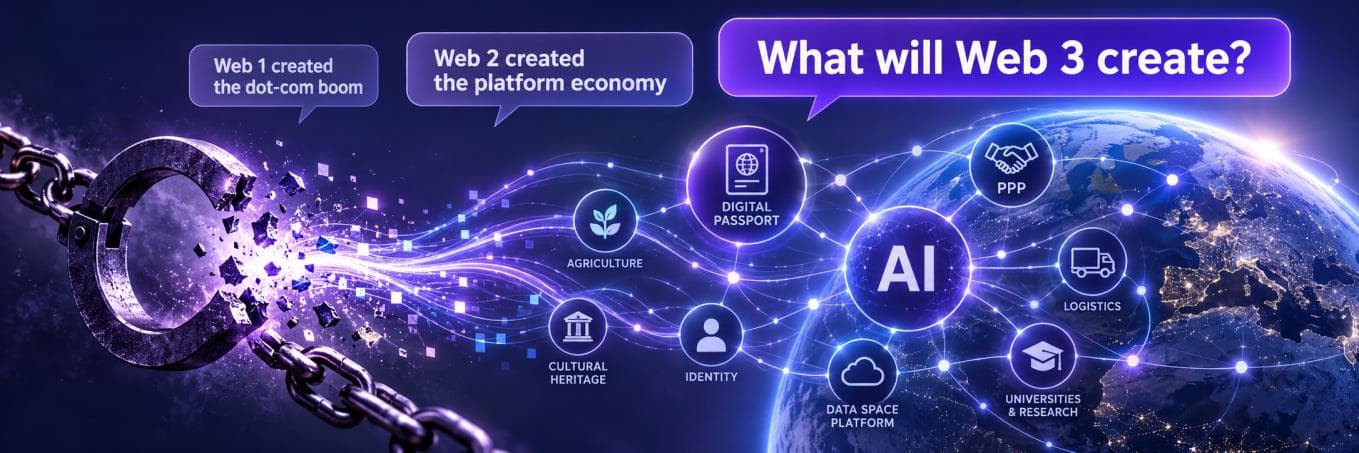
Web 3.0 Data Space (W3DS) is conceived as the third generation of Tim Berners-Lee’s World Wide Web, providing a universal infrastructure for sovereign data and digital identities across all industries. This architecture also provided our answer to the European Memory Data Space (EMDS) project’s request for a Data Space.
One year after launching the W3DS ecosystem, this joint conference will demonstrate working applications across multiple domains and explore commercial implementations for 2027. Participants will experience W3DS firsthand, from registration to interacting with speakers.
One Data Space. Thousands of Use Cases.
This will not be a technical conference. The technology works. The question is what it changes – and how to scale it.
What you will see
- W3DS in a nutshell. Digital Sovereignty, Trust, Longevity, no Data Silos, no Vendor Lock-in
- One year. Real projects. Working systems from cultural heritage, agriculture, Commons, enterprises, governments, finance, universities and research – presented by the people who own, run and use them. One Data Space allows the same original data to be reused across domains instead of being copied into separate silos
- Data becomes permanent. Software becomes disposable. Shared identity, trust, security and data continuity let AI-assisted applications be created quickly, live briefly when needed, and still work with the same long-lived data
- Value and real paths to adoption. How lower structural costs, better HR, evidence-based investment and new services create practical incentives for enterprises, investors, integrators, developers and public institutions to move into W3DS
- From working systems to scale infrastructure. Creating value measured in several percent of global GDP would require a deployment effort far beyond any single government, company or community. We will discuss policy, legal and investment questions, including the role of Public-Private Partnerships in building the next Web together.
For whom
Who you’ll hear from
Project owners and people already building, using and funding W3DS – from Post-Platforms Foundation, W3 Alliance, eCommons, MetaState, W3DS-Agro and EMDS to universities, government, investors, consultants and system integrators
Programme
18 talks across four parts, 13:00–17:00, with a coffee break — and a borrel afterwards. Times are local to Amsterdam (CET).
- Part 1
From Functional Requirements to Working Infrastructure
Why Data Space, what it must achieve, and how the requirements became a working system.
- Why Data Space? Functional RequirementsFranca Boender Ministry of Economic Affairs, the Netherlands
- Functional Requirements: Minimal Agreements for Maximum Interoperability (MAMI)Pieter Verhagen CoE-DSC (Centre of Excellence for Data Sharing and Cloud)
- Web 3.0 Data Space: From Requirements to Working Infrastructure – The EMDS CaseAlex Tourski Post-Platforms Foundation
- W3DS: Challenges and Research PerspectivesHerman Pals TNO
- Part 2
W3DS in Practice
Real projects presented by the people building and using them.
- Reality Check: Can We Use Our Own Products Inside the W3DS Team?Alex Tourski Post-Platforms Foundation
- It’s Your Turn: Let’s Try W3DS Right NowYekaterina Travkina CoE-DSC (Centre of Excellence for Data Sharing and Cloud)
- W3DS Agro: How to Free the Farmer?René Kremers DIFCO
- AI Weeds: Building a Market for AI Training DataEgor Yakovlev Post-Platforms Solutions
- Amsterdam eCommons: Sovereign Digital Governance for CommunitiesSergei Zhilin eCommons Vereniging
- Digital Product Passport: Introducing the ConnectomeEgor Yakovlev Post-Platforms Solutions
- Coffee break
- Part 3
From Use Cases to Business
How a working Data Space becomes a market, an implementation ecosystem and an investable proposition.
- Investor Perspective: Why I Invested in W3DSOleg Radzinsky Private Investor & Philanthropist
- Building the W3DS Market: Balancing Government, Business and Social InterestsAlex Tourski Post-Platforms Foundation
- Will Governments Use W3DS? Luxembourg Cases: W3 Office and Cross-Border Digital MigrationBert Verdonck Luxembourg National Data Service
- Will Businesses Use W3DS? Approaching Corporations Through System IntegratorsRené Mijs W3 Alliance
- Will Communities Use W3DS? Timebanking: A Shared Payment System for CommunitiesAnita van der Stap eCommons Vereniging
- Part 4
From Business to Infrastructure: PPP for Data Space
Can methods used to build physical infrastructure help accelerate shared digital infrastructure?
- Can We Build a Data Highway the Way We Build Highways?Jan van Schoonhoven PPP Expert; National Center for Privatization & PPP, Saudi Arabia
- The Big Picture: Putting It All TogetherAlex Tourski Post-Platforms Foundation
- Closing ReflectionFranca Boender Ministry of Economic Affairs, the Netherlands
One Data Space. Thousands of Use Cases.
Venue
The red line on the map is the walk from Amsterdam Centraal, east along the Oosterdokskade.

Take a seat
Registration is open
26 November 2026, 13:00–17:00, Amsterdam Public Library — Forum, 6th floor. Admission is free.